🔎
Question the source
Learn how to examine who created information, what evidence is offered, and why it was published.
MEDIA • INFORMATION • DIGITAL LIFE
Welcome to Media Literacy Lab — a learning space for understanding media, questioning information, recognizing misinformation, and becoming a smarter digital citizen.
THE MEDIA LITERACY CHECK
Who created this? Why? What evidence supports it? What might be missing?
START HERE
Simple explanations and practical ways to navigate today's information environment.
Learn how to examine who created information, what evidence is offered, and why it was published.
Recognize emotional triggers, persuasive techniques, bias, context, and missing information.
Use practical verification habits before accepting or passing information along.
EXPLORE
Topics we'll explore through lessons, examples, videos, and articles.
Understand the difference and learn how misleading information spreads.
02Explore reporting, news values, sources, headlines, and credibility.
03Think critically about AI-generated text, images, video, and information.
04Develop responsible habits for participating in today's digital world.
MEDIA LITERACY BASICS
Misinformation means sharing false or wrong information without intending to deceive others. People who pass it on usually believe it is true and want to help, but the facts are wrong. Even when there is no bad intent, misinformation can still cause problems.
For example, imagine someone sees a social media post claiming that a popular app is going to start charging all users a monthly fee. Believing the post is genuine, they share it with their friends and warn them to be prepared. The information is actually false, but the person who shared it was not trying to trick anyone—they simply believed the claim without checking the source. That is misinformation.
The main difference between misinformation and other types of false information is the intent behind sharing it. Let's see how it compares with disinformation and malinformation.
UNDERSTAND THE DIFFERENCE
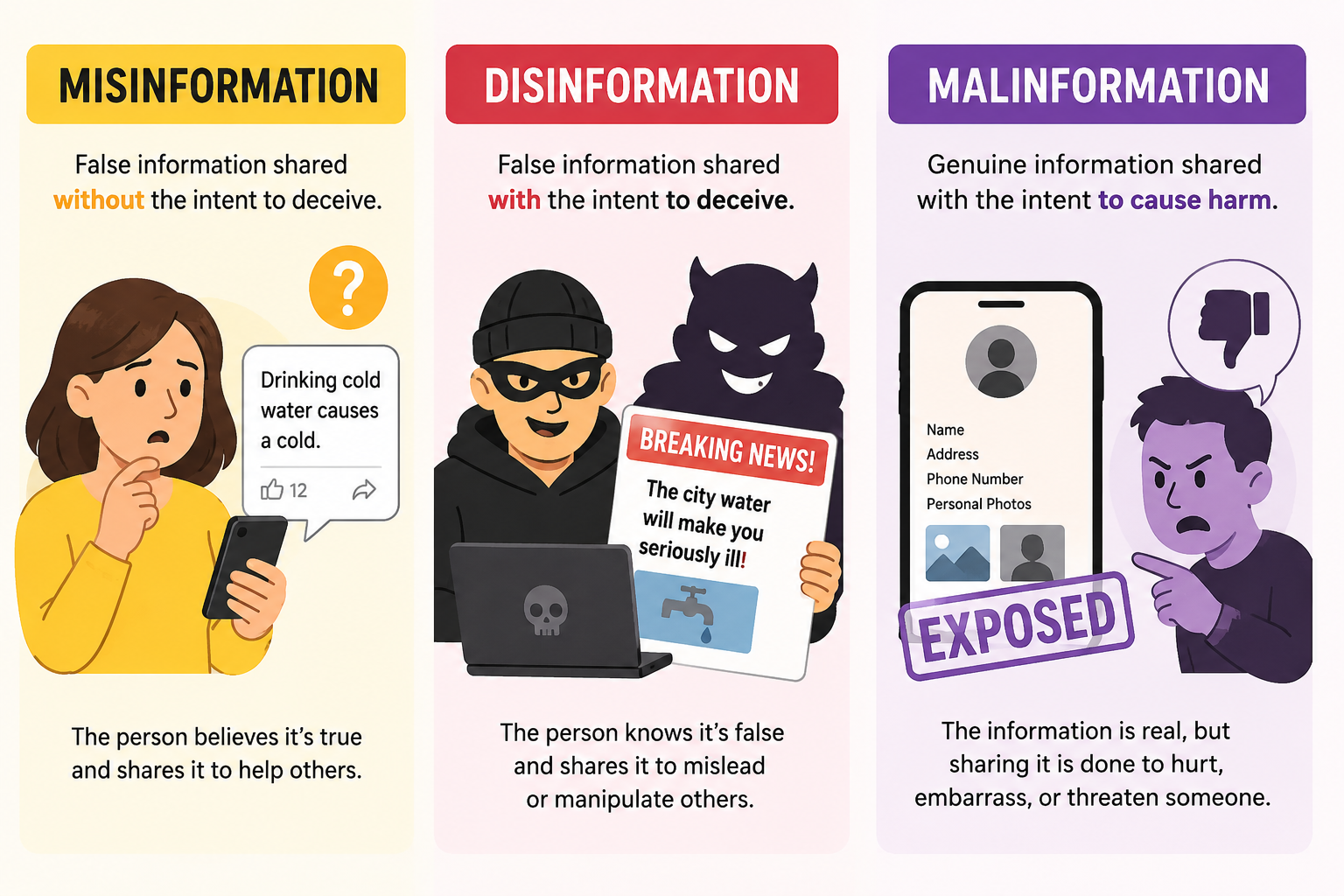
Though these terms sound alike, they describe different things. Here is what each one means:
People may believe the information is true and share it to help others. The information is false, but there is no intention to mislead.
Disinformation is false information that is spread deliberately to mislead or cause harm. The person or group sharing it knows it is not true but still shares it to confuse people, promote an agenda, or create conflict. Disinformation has been used in political campaigns, election interference, and scams.
This often happens when someone shares private information or takes facts out of context to embarrass or harm another person. For example, sharing private messages publicly to shame someone is malinformation. The information is true, but it is used in a harmful way.
| Type | Is the information true? | Is there an intention to deceive? | Simple example |
|---|---|---|---|
| Misinformation | ❌ False | ❌ No | Someone shares a false social-media claim because they genuinely believe it is true. |
| Disinformation | ❌ False | ✅ Yes | Someone deliberately creates a false story and shares it to mislead people. |
| Malinformation | ✅ Usually true | ✅ Yes, to cause harm | Someone shares a person's genuine private information publicly to embarrass or harm them. |
EASY WAY TO REMEMBER
JOURNALISM & NEWS
Every day, important events happen around us. Governments make decisions, communities face challenges, people achieve remarkable things, and unexpected events capture public attention. Journalism helps us learn about these events and understand what is happening in the world.
Journalism is the process of gathering, verifying, and presenting information about events and issues that are important to the public.
Journalists collect information from different sources, investigate facts, interview people, and communicate their findings through newspapers, television, radio, websites, podcasts, and other digital platforms.
THE MAIN PURPOSE OF JOURNALISM
To inform people about important events and issues.
To educate the public about topics that affect society.
To investigate problems and uncover important information.
To hold powerful individuals and institutions accountable.
To give people the information they need to make informed decisions.
JOURNALISM IS MORE THAN JUST SHARING INFORMATION
Today, almost anyone can share information online. A person can post a video, write a comment, or share a news story within seconds. However, sharing information is not always the same as journalism.
Journalism usually involves important processes designed to help produce information the public can trust:
JOURNALISM IN THE DIGITAL AGE
Journalism has changed significantly with the growth of the internet and social media. News is now published and shared faster than ever before. People can receive breaking news updates through smartphones, websites, social media platforms, and news apps.
However, the speed of digital communication also creates challenges. False information, misleading headlines, manipulated images, and unverified claims can spread quickly online.
This makes responsible journalism—and media literacy—more important than ever.
WHY SHOULD WE UNDERSTAND JOURNALISM?
Understanding journalism helps us become better news consumers. When we understand how journalists gather and verify information, we are better able to evaluate the news and information we encounter every day.
MEDIA LITERACY CONNECTION
Being media literate means understanding that not all information is created in the same way. Journalism follows processes designed to gather, verify, and communicate information to the public. By understanding these processes, we can become more thoughtful and responsible consumers of news.
KEY TAKEAWAY
It involves gathering, verifying, and presenting information that helps the public understand the world around them. In today's fast-moving digital environment, understanding journalism is an important part of becoming a media-literate citizen.
WATCH & LEARN
Short, accessible lessons for students, teachers, and curious minds.
Watch on YouTubeREAD
Articles and explainers about media, journalism, technology, and information.
Learn how journalism gathers, verifies, and presents information for the public.
Read more →Explore how generative AI is changing the information environment.
Read more →A clear, classroom-friendly explanation of misinformation, disinformation, and malinformation.
Read more →FOR LEARNERS & EDUCATORS
Lesson ideas, media literacy activities, checklists, quizzes, and downloadable learning materials will live here.
ABOUT THE LAB
Media Literacy Lab is a space dedicated to helping people become more thoughtful consumers and creators of media. The Lab brings together media literacy, journalism, digital citizenship, misinformation, and emerging technology.
ABOUT THE FOUNDER
Media Educator & Founder, Media Literacy Lab
Media Literacy Lab was created to make media literacy clear, practical, and accessible— helping learners ask better questions, evaluate information, and navigate the digital world with greater confidence.